
AI will give us more time to do ..... what?

Observing the landscape of global business, many of their value propositions follow a familiar theme:
“We save you X amount of time so that you can focus on what truly matters”
It is a message you've likely seen countless times.
And as technology advances, this promise is evolving into something more profound.
It will no longer solely be about saving time, but one day, replacing the function altogether.
Like: “AI can do this task better than humans, freeing up our time entirely.”
And while the value for businesses are undeniably real - with clear ROI - there’s a broader existential phenomenon being created: a type of “AI washing.” It promotes the comforting illusion that as technology takes over human tasks, we will naturally gain more meaningful time for ourselves. To do .... whatever we want.
And the evidence suggests that the world is increasingly bullish on moving in that direction - towards offloading more and more tasks to technology.
AI Agents Market chart by Grand View Research

While AI agents are advancing rapidly and headlines about mass layoffs attributed to AI are becoming more common, as seen recently with Jack Dorsey's, Block.
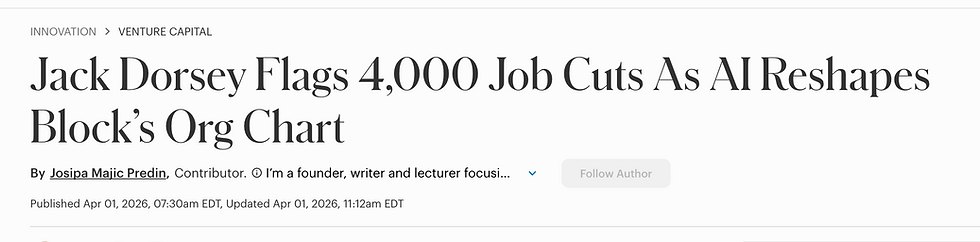
There is not enough data to suggest that AI will lead to mass unemployment, at least not yet. As of today, most technologies still require supervision or semi-supervision, so there is almost always a human involved in the process. But it remains an open question whether, as these technologies become more capable, human input will still be necessary at all.
However, there is one noticeable shift in the unemployment data: recent college graduates, particularly those under 24, are being disproportionately affected. This may be because companies have a reduced need for entry-level skill sets, many of which are increasingly being supplemented or replaced by AI. The concept of the prototypical "first job" is at risk.

Presuming the world continues trending in this direction, AI agents will keep growing, and they will become smarter. And so then, the idea is that we would have more time available as these agents handle our mundane tasks, right? We now have more free time, correct?
So let's say then, with those extra free hours, I go to a coffee shop seeking some connection to the world. Because now through work, I mostly spend time with my personal AI agent that does most of my work for me.
I arrive, only to be greeted by an iPad at the counter prompting me to place my order. I tap in my selection and pay with my phone - efficient, seamless. The coffee shop owner, after all, also believes in efficiency.
In the background, a worker (or perhaps, a robot) prepares my drink, places it on the counter, and offers a brief “have a nice day” as I pick it up.

Some people will enjoy the efficiency, but many will feel the absence of the human interaction.
The promise of automation is that by removing friction and outsourcing tasks to machines, we free ourselves to 'focus on what matters'. But what if, in this process, we lose something meaningful? What if there is true value, even beauty, in the mundane tasks we are so eager to eliminate?
For example, ordering and small talk from a human teaches us communication and empathy. Doing the dishes builds patience. Getting lost strengthens our problem-solving skills. Reading a full-length article sharpens our ability to think critically. Conducting work meetings with humans teaches us active listening. The list goes on and on - useful life skills that help shape who we are and make us uniquely human.
The hope for the future:
There are many applications of AI that are clearly beneficial to the well-being of the planet and involve undeniably useful technology. My hope is that investment, government support, and global consensus increasingly shift toward those industries - such as biology, medicine, environmental science, and renewable energy - where AI can have the most meaningful and positive impact. To solve real global challenges.
But the current status quo, it seems to be about creating vast numbers of new AI agents to automate the work of the lovely admin receptionist who greets each arrival, the 19-year-old intern manually combing through reconcilliation reports to extract insights, the barista carefully crafting every coffee, and the customer service representative patiently resolving complaints - roles made far more meaningful by human presence - or, if not meaningful, still necessary for teaching us the fundamentals.
And so, if we keep tracking in the same direction, why will we bother doing anything, when AI can do it for you ....
Previous articles on subject matter: